
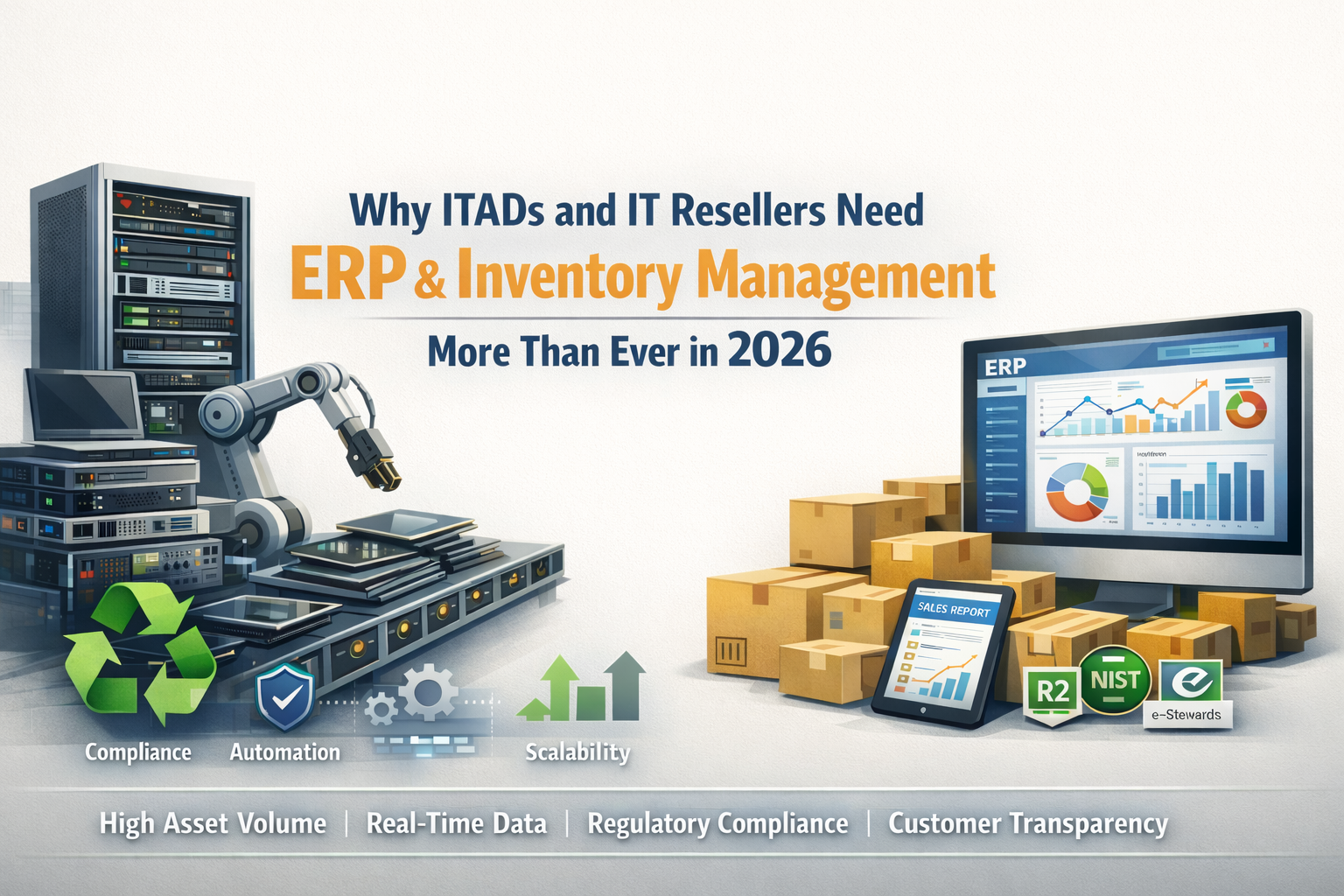
Why ITADs and IT Resellers Need ERP and Inventory Management More Than Ever in 2026
- Published On: 5th Mar, 2026
The IT asset disposition (ITAD) and IT resale industries have evolved rapidly over the past decade. What once operated as relatively manual, relationship-driven businesses are now complex, data-driven operations that must process high volumes of equipment quickly while maintaining strict compliance and transparency. In 2026, the pressure on ITAD providers and IT resellers is greater than ever. Organizations are handling larger asset refresh cycles, stricter environmental regulations, and increasing customer demands for detailed reporting.
To meet these challenges, ITAD companies and IT resellers are turning to Enterprise Resource Planning (ERP) and advanced inventory management systems. These platforms are no longer just helpful tools—they are becoming essential infrastructure for companies that want to automate operations, scale effectively, streamline processes, and maintain compliance.
Below are several key reasons why ERP and inventory management systems are critical for ITADs and IT resellers in 2026.
The Explosion of IT Asset Volume
The sheer volume of IT equipment entering the secondary market has grown dramatically. Organizations are upgrading hardware more frequently due to accelerated technology cycles, cloud adoption, and AI infrastructure demands. Devices that once stayed in service for five or six years may now be replaced in three years or less.
For ITAD companies, this means processing larger batches of assets—from laptops and servers to networking equipment and mobile devices. Without a centralized system to track these assets, businesses risk losing visibility into inventory, creating bottlenecks in processing, and introducing costly errors.
ERP and inventory systems provide a single source of truth for every device. From intake and testing to resale, recycling, or destruction, each asset can be tracked throughout its lifecycle. This visibility enables teams to process higher volumes of equipment without sacrificing accuracy.
Automation Is No Longer Optional
Manual processes have long been a challenge in the ITAD industry. Many organizations still rely on spreadsheets, disconnected tools, and human intervention to manage asset tracking, reporting, and inventory updates.
In 2026, that approach is increasingly unsustainable.
ERP systems enable automation across multiple workflows, including:
- Asset intake and serialization
- Testing and grading workflows
- Inventory updates
- Sales order processing
- Logistics and shipping documentation
- Certificate generation for data destruction
By automating these tasks, companies reduce the risk of human error while significantly increasing operational efficiency. Automation also allows employees to focus on higher-value tasks such as sales, vendor relationships, and operational optimization.
Scalability for a Growing Industry
Many ITAD businesses reach a point where growth becomes difficult to manage with manual systems. As operations expand—more customers, more warehouse locations, more inventory—complexity increases dramatically.
Without the right systems in place, companies experience:
- Inventory mismatches
- Delayed order fulfillment
- Limited reporting visibility
- Inefficient warehouse operations
ERP systems allow businesses to scale without chaos. Modern ERP platforms integrate inventory, warehouse management, finance, CRM, and logistics into one cohesive system. This allows ITADs and resellers to grow their operations without constantly reinventing processes.
For example, when a company expands into new facilities or regions, an ERP system ensures inventory and workflows remain synchronized across locations. Teams can access real-time data from anywhere, ensuring consistent operations and faster decision-making.
Streamlined Operational Processes
Another major benefit of ERP systems is process standardization.
Many ITAD companies grow through partnerships, acquisitions, or organic expansion. Over time, this often results in inconsistent workflows across departments or locations. One team may track assets one way, while another team uses entirely different procedures.
ERP systems help organizations establish standardized processes that improve efficiency and accountability. With a centralized platform, companies can implement consistent workflows for:
- Asset intake and scanning
- Testing and grading procedures
- Inventory classification
- Sales listing creation
- Shipment tracking
Standardization not only improves operational efficiency but also ensures employees follow repeatable processes that reduce errors and improve service quality.
Compliance and Regulatory Readiness
Compliance has become one of the most critical aspects of the ITAD industry. Companies must meet strict regulatory and security requirements related to data destruction, environmental recycling, and asset tracking.
In 2026, clients expect ITAD providers to demonstrate compliance with standards such as:
- R2 (Responsible Recycling)
- e-Stewards
- NIST data destruction guidelines
- Environmental and sustainability reporting
Without a centralized system, generating the documentation needed to support compliance can be time-consuming and error-prone.
ERP systems simplify compliance by automatically capturing key operational data throughout the asset lifecycle. This data can be used to generate reports such as:
- Certificates of data destruction
- Asset audit trails
- Recycling documentation
- Environmental impact reports
- Client transparency reports
With built-in reporting capabilities, companies can respond quickly to audits and customer inquiries while maintaining confidence in their documentation.
Real-Time Data and Business Intelligence
Data has become a competitive advantage in the ITAD industry.
Companies that understand their inventory, processing times, resale margins, and vendor performance can make smarter business decisions. Unfortunately, when data is spread across spreadsheets or disconnected systems, gaining meaningful insights becomes difficult.
ERP platforms centralize operational data and provide real-time dashboards that allow leaders to monitor key metrics such as:
- Inventory levels
- Asset processing speed
- Sales performance
- Profit margins by product category
- Vendor and client activity
This level of visibility enables organizations to identify bottlenecks, improve pricing strategies, and optimize warehouse operations.
In a market where margins can be tight, data-driven decision making is a major advantage.
Improved Customer Transparency
Clients today expect more visibility into what happens to their retired IT assets. Enterprises want to know where their equipment goes, how it is processed, and whether it is reused, resold, or recycled responsibly.
ERP systems allow ITAD providers to offer better transparency and reporting to customers. Through automated reporting and asset tracking, companies can provide detailed documentation that builds trust and strengthens long-term relationships.
This transparency also supports corporate sustainability goals. Many organizations now track their environmental impact and rely on ITAD providers to help them demonstrate responsible asset disposal.
Integration with Modern Sales Channels
IT resellers increasingly rely on multiple sales channels to move inventory efficiently. These channels may include:
- Online marketplaces
- Wholesale partners
- Direct B2B sales
- E-commerce platforms
ERP systems can integrate with these channels, automatically updating inventory levels and synchronizing product listings. This prevents overselling, improves order accuracy, and speeds up fulfillment.
For companies moving thousands of devices each month, this integration is critical to maintaining operational efficiency.
Future-Proofing the Business
The ITAD industry will continue to evolve. Technologies such as AI-driven asset grading, predictive inventory analytics, and automated logistics are already beginning to reshape the market.
Companies that rely on outdated tools may struggle to adapt to these changes. ERP systems provide a scalable foundation that allows businesses to integrate new technologies and processes as the industry evolves.
In other words, ERP is not just a solution for current challenges—it is an investment in the future.
Conclusion
In 2026, the ITAD and IT resale industries operate in a fast-paced, high-volume environment that demands efficiency, transparency, and compliance. Manual processes and disconnected systems can no longer support the scale and complexity required to compete.
ERP and inventory management systems provide the infrastructure needed to automate operations, streamline workflows, maintain regulatory compliance, and scale efficiently. They empower organizations with real-time data, improved operational visibility, and the ability to deliver the transparency customers expect.
For ITAD providers and IT resellers looking to grow and remain competitive, implementing a modern ERP and inventory management system is no longer optional—it is essential.
